PPWR: The EU Packaging Regulation Explained in Plain Terms
The comprehensive guide for manufacturers, retailers, and online shops
On August 12, 2026, the Packaging and Packaging Waste Regulation – PPWR for short – becomes binding in all 27 EU member states. It replaces the Packaging Directive and fundamentally changes who is responsible for packaging, how it must be designed, and what companies must be able to prove in each individual EU country. In this guide, we explain step by step what the PPWR regulates, what the authorized representative is all about, which role your company plays in it, and what you should do now in concrete terms.
- 00Days
- 00Hours
- 00Minutes
- 00Seconds

Key Takeaways
The PPWR is an EU regulation (Regulation (EU) 2025/40) and applies from August 12, 2026 directly in all EU member states – unlike the previous directive, without national implementing legislation. Anyone who makes packaging or packaged products available in an EU country for the first time without being established there will, as a rule, need an authorized representative in that country from this date onward. National registration and licensing obligations continue to exist alongside it – the PPWR does not replace your packaging license. There is no de minimis threshold: the obligations apply from the very first parcel. From 2030, all packaging on the EU market must be recyclable, and plastic packaging must contain minimum shares of recycled content.
What is the PPWR?
The PPWR (Packaging and Packaging Waste Regulation) is Regulation (EU) 2025/40 on packaging and packaging waste. It was published in the Official Journal of the European Union on January 22, 2025, entered into force on February 11, 2025, and, after a transition period of 18 months, applies bindingly in all EU member states from August 12, 2026. It replaces the Packaging Directive 94/62/EC from 1994.
The difference between a directive and a regulation is more than a legal footnote. A directive must be transposed into national law by each member state; this is how, over three decades, 27 different packaging laws emerged, each with its own registers, thresholds, and deadlines – in Germany, for example, the Packaging Act (VerpackG) with the LUCID register. A regulation, by contrast, applies directly and word for word in every EU country, without any national parliament having to implement it.
The numbers show why the EU is taking this step: around 40 percent of all plastics used in the EU go into packaging, roughly half of the litter in the oceans comes from packaging waste, and each EU citizen produces an average of 186.5 kilograms of packaging waste per year. The previous rules were unable to stop this trend. The PPWR therefore sets significantly stricter targets: less packaging waste, mandatory recyclability of all packaging by 2030, minimum shares of recycled plastic, bans on particularly short-lived single-use formats, and binding reuse quotas.
Important to understand: the PPWR primarily harmonizes the requirements for the packaging itself (design, material, labeling) and the basic obligations of companies. The practical implementation – national producer registers, waste management systems, sanctions – remains a matter for the member states. For companies selling across borders, this means: uniform rules of the game, but still 27 different playing fields.
Timeline: What Applies When?
The PPWR does not come into force all at once, but in stages over more than a decade. That gives companies time – but the most important obligations arrive right at the start. The following timeline shows the key dates:
Regulation (EU) 2025/40 enters into force. The 18-month transition period begins, during which companies can prepare.
The PPWR applies bindingly in all EU member states. From now on, the authorized representative requirement for companies without an establishment in the target country takes effect, along with the conformity assessment procedure with EU declaration of conformity and technical documentation, as well as the new PFAS limits for food packaging.
Member states must have established their penalty rules for PPWR infringements. Producers may indicate fulfillment of their EPR obligations with a symbol in a QR code.
Every EU member state must have set up a national producer register. Companies will then also have to register in countries where no register previously existed.
Permeable tea and coffee bags as well as fruit and vegetable stickers must be compostable.
Packaging must be labeled uniformly across the EU regarding its material composition (or 24 months after the implementing acts enter into force). In addition, the obligation begins to inform consumers about collection, reuse, and waste prevention.
Only recyclable packaging (at least performance grade C, i.e., 70% recyclability) may be placed on the market. Minimum recycled-content shares for plastic packaging become binding. Certain single-use plastic formats are banned. Packaging may only have the weight and volume functionally necessary; shipping, transport, and grouped packaging may have a maximum of 50% empty space. The first reuse quotas take effect.
Packaging must demonstrably be recyclable at large scale.
Packaging must achieve at least 80% recyclability.
Recycled-content and reuse quotas are raised significantly once again.
Who Is Affected by the PPWR?
The short answer: practically every company that manufactures, imports, or sells packaging or packaged products in the EU. The PPWR applies to all packaging regardless of material (from the shipping box to the product packaging to the filler material) and to all economic sectors.
The obvious cases are affected first: packaging manufacturers, brand owners who put their products on the market in packaged form, and importers who bring packaged goods from third countries into the EU. But online retailers are equally affected, regardless of their size. Anyone who runs a web shop and ships products in their own boxes, who sells into several EU countries via Amazon FBA, or who has products filled under their own brand takes on obligations under the PPWR. There is no de minimis threshold: the obligations apply from the very first parcel shipped.
The decisive factor is cross-border selling. The PPWR ties its obligations to making packaging available in a member state for the first time. In online retail in particular, this happens in every country you deliver to. Anyone who sells into eight EU countries has obligations in eight countries: registration, volume reporting, cost contributions – and, without their own establishment in the target country, the appointment of an authorized representative.
Just as important is who is less affected: anyone who sells exclusively in Germany to German customers does not need an authorized representative. Essentially, the familiar obligations remain (LUCID registration, packaging license), which in the future will follow from the PPWR and the new German Packaging Law Implementation Act. And for micro-enterprises (fewer than 10 employees and no more than €2 million in annual turnover or balance sheet total), the PPWR provides for selective relief – for example, that in certain constellations the packaging supplier takes their place, provided both are established in the same member state.
The Roles in the PPWR: Who Counts as What – and Who Has to Do What?
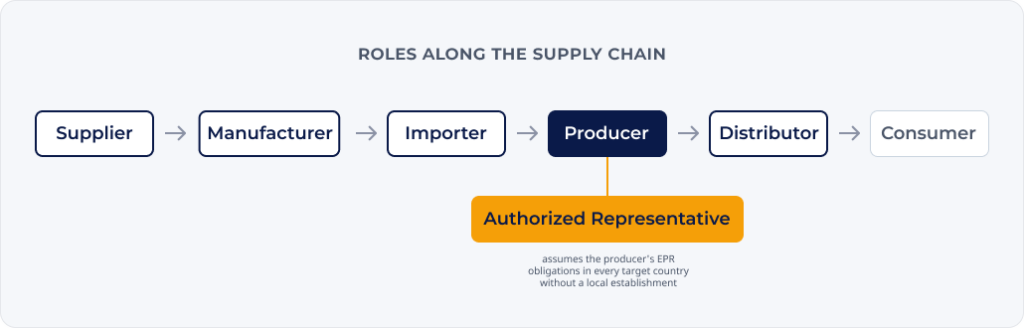
Supplier
A supplier is anyone who supplies packaging or packaging materials to a manufacturer – for example, corrugated board producers, film manufacturers, or wholesalers of shipping packaging.
The obligations: The supplier must provide the manufacturer with all information and documentation needed to demonstrate conformity: on material composition, recycled-content shares, and substance limits (Art. 42 PPWR). Without this information, the manufacturer can neither compile the technical documentation nor issue the EU declaration of conformity.
Manufacturer
A manufacturer (Art. 3(1)(13) PPWR) is anyone who produces packaging or packaged products – or has them developed or produced under their own name or brand. This applies regardless of whether the producing company is also named on the packaging: the brand owner remains the manufacturer. An online shop that has cosmetics filled under its own brand is therefore the manufacturer of that packaging, even if a contract filler does the work.
The obligations: The manufacturer must ensure that its packaging meets the requirements of Articles 5 to 12 PPWR (substance limits, recyclability, recycled content, minimization, labeling). To that end, from August 12, 2026, it must carry out a conformity assessment procedure, compile the technical documentation in accordance with Annex VII, and issue the EU declaration of conformity in accordance with Article 39. It must retain both – five years for single-use packaging, ten years for reusable packaging – and present them to the authorities on request.
Producer
Responsible for registration and waste management costs
A producer (Art. 3(1)(15) PPWR) is – put simply – anyone who makes packaging or packaged products available in a member state for the first time, including from abroad in the case of cross-border direct sales to end users. In distance selling, the online retailer itself thus becomes the producer in the target country.
The obligations: The producer bears the extended producer responsibility (EPR). It must register in the national producer register of every country in which it makes packaging available for the first time (without registration, a sales ban applies, Art. 44), regularly report the packaging volumes sold, and pay financial contributions for collection and recycling – in practice, through participation in a take-back scheme (“packaging license”). If it has no establishment in the target country, it must appoint an authorized representative there.
Importer
Responsible for compliant goods from third countries
An importer is anyone who places packaging or packaged products from a non-EU country on the EU market for the first time – sourcing from another EU country is not an import within the meaning of the PPWR. Anyone sourcing directly from China or Switzerland falls into this role.
The obligations: The importer may only import compliant packaging. It must verify that the manufacturer has carried out the conformity assessment procedure, keep a copy of the EU declaration of conformity available, state its contact details on the packaging or in accompanying documents, and ensure proper storage and transport. Depending on the constellation, the importer is additionally a producer – with all EPR obligations.
Distributor
A distributor is anyone who makes packaging or packaged products further available on the market without having manufactured or imported them – the classic reseller of pre-packaged branded goods.
The obligations: The distributor has verification duties: it must ensure that the goods are labeled, that a declaration of conformity exists, and that the producer is registered in the target country. It may not offer non-compliant products.
Fulfilment Service Provider
Responsible for proper handling
Fulfilment service providers store, package, address, and dispatch goods for third parties without owning them. They may only provide their services to producers who can demonstrably fulfill their EPR obligations – otherwise they must suspend the cooperation. Online marketplaces must also verify that their sellers are registered: without a valid EPR registration number, listings face suspension – as Amazon and others are already enforcing today for individual countries.
Authorized Representative
The proxy in the target country
The authorized representative (Art. 45 PPWR) is a person or company established in the target country that, by written mandate, takes on the producer’s EPR obligations: registration, volume reporting, and acting as the point of contact for the authorities. It is not a separate economic operator level, but the legal anchor of foreign companies in every country where they have no establishment of their own.
Because it is the central figure for the authorized representative requirement starting in August 2026, we explain in the next section when a producer needs an authorized representative in a given country.
The PPWR Obligations in Detail
The PPWR bundles a whole series of requirements that take effect at different points in time. The following obligation areas are the most relevant for most companies. For each one, we state who the obligation primarily affects.
1. Authorized Representative per EU Country
Affects: producers without an establishment in the target country
From August 12, 2026, producers must appoint an authorized representative for extended producer responsibility in every EU country in which they make packaging available for the first time without being established there. Since this obligation is the most immediate consequence of the PPWR for companies selling across borders, we cover it in detail in the next chapter.2. Registration in National Producer Registers
Affects: producers
Anyone who makes packaging available in an EU country for the first time must register in that country's national producer register – in Germany, this has been the ZSVR's LUCID register for years. What's new: by October 2027, every member state must maintain such a register, and the registration number must be provided on online marketplaces. Without registration, a sales ban applies (Art. 44(4) PPWR). A two-tier system will apply to volume reporting in the future: below 10 tonnes of annual volume, a simplified report by base material is sufficient (glass, plastic, paper/cardboard, ferrous metals, aluminum, wood, other); above that, reporting is more detailed by packaging type. Member states may lower this threshold – the details are regulated by each country itself.3. Licensing of Packaging and Volume Reporting
Affects: producers
Anyone who makes packaging available in an EU country for the first time must, as a rule, join a PRO there (in Germany, these are the dual systems) and purchase a packaging license for their packaging volumes. These fees finance the national collection and recovery costs that arise when your packaging is disposed of by the end consumer in the target country. If you have no establishment in that country, the authorized representative takes care of all necessary steps for you. You then only pay the applicable license fees.4. Recyclability (Design for Recycling)
Affects: manufacturers
From January 1, 2030, only recyclable packaging may be placed on the market. Packaging is graded into performance levels for this purpose: grade A (at least 95% recyclable), B (at least 80%), and C (at least 70%). Anything below 70% is excluded from the market from 2030; from 2038, at least grade B is mandatory. From 2035, packaging must additionally be demonstrably recycled "at scale," i.e., at large volume. The European Commission will set the exact assessment criteria in delegated acts by 2028. Design for recycling already pays off twice today: from mid-2031, EPR contributions will be eco-modulated – the better the recyclability, the lower the fees.5. Minimum Recycled Content in Plastics
Affects: manufacturers and importers of plastic packaging
From January 1, 2030, every plastic part of a packaging item must contain defined minimum shares of post-consumer recycled content: 30% for contact-sensitive PET packaging, 10% for other contact-sensitive plastic packaging, 30% for single-use beverage bottles, and 35% for all other plastic packaging. On January 1, 2040, the quotas rise significantly (to 50/25/65/65%). Exemptions include pharmaceutical packaging, compostable plastics, and packaging with a plastic share of less than 5% of the total weight. Here too: higher recycled content will lower your EPR costs in the future.Interim conclusion: Design for recycling and high recycled-content shares are not just mandatory from 2030 – from mid-2031 they also directly reduce your EPR fees via eco-modulation. Anyone purchasing new packaging now should factor in both from the start.
6. Labeling and Marking
Affects: manufacturers; verification duties for importers and distributors
From August 2028 (or 24 months after the relevant implementing acts), packaging must be labeled uniformly across the EU with regard to its material composition – with harmonized pictograms that show consumers the correct disposal route. Labels must be clearly visible, legible, and firmly affixed; for small packaging, a QR code is permissible. From February 2029, reusable packaging will mandatorily require a QR code or other digital data carrier with information on return and reuse. Important for online retailers: the mandatory information must also be visible in the shop before purchase. National special markings such as the French Triman logo will remain in place in parallel for the time being.7. Packaging Minimization
Affects: manufacturers and importers; in practice, every shipper
From January 1, 2030, packaging may only have the weight and volume required for its function – double walls, false bottoms, and showcase packaging will then be prohibited. For mail order, transport, and grouped packaging, an additional hard limit applies: a maximum of 50% empty space. And beware: bubble wrap, packing chips, and similar filler material count as empty space. Compliance must be demonstrated in the technical documentation. Anyone who optimizes their box sizes early saves twice: on shipping costs and on future EPR fees.8. Declaration of Conformity and Technical Documentation
Affects: manufacturers; retention duties for importers and distributors
From August 12, 2026, a conformity assessment procedure must be carried out for every type of packaging placed on the EU market. The manufacturer compiles the technical documentation in accordance with Annex VII and issues the EU declaration of conformity in accordance with Article 39 – the proof that the packaging meets the requirements of Articles 5 to 12. From 2026, this also includes the new substance rules: in addition to the familiar upper limit of 100 mg/kg for lead, cadmium, mercury, and hexavalent chromium, food packaging may no longer be placed on the market if it contains PFAS above defined limits. The documents must be retained for 5 years (single-use) or 10 years (reusable).
For this obligation, the PPWR provides relief for micro-enterprises (< 10 employees & max. €2 million turnover): if micro-enterprises source packaging bearing their own logo from a supplier in the EU, the supplier is deemed the manufacturer and must ensure conformity and documentation.
What this means for you: Not every obligation hits every company immediately. From August 2026, three things matter above all: appointing authorized representatives, checking registrations, and organizing declarations of conformity. The design requirements (recyclability, recycled content, minimization) have a lead time until 2030 – but anyone purchasing new packaging now should already take them into account.
The Authorized Representative Requirement from August 12, 2026
Of all the PPWR’s new provisions, the authorized representative requirement has the most immediate consequences for companies selling across borders: it takes effect right at the date of application and affects every distance seller.
Who Needs an Authorized Representative?
Art. 45(3) PPWR obliges producers who make packaging or packaged products available in a member state for the first time without being established there to appoint an authorized representative for extended producer responsibility in that country. Translated, this means: a German online shop selling to Austria, France, and Spain needs three authorized representatives – one per country. There is no EU-wide one-stop solution, because the PRO systems remain organized nationally. Companies from third countries (Switzerland, UK, USA) selling into the EU also need authorized representatives in their target countries.
What Does an Authorized Representative Do?
The authorized representative is a natural or legal person established in the target country that, by written mandate, takes on the producer’s EPR obligations: registration in the national producer register, the regular volume reports, and the role of contact point for the local authorities. It ensures that you legally “exist” in that country without having to set up an establishment there. Depending on the country and provider, the costs typically range from a few hundred euros per country per year. On top of that come the actual license fees for your packaging volumes.
What Happens Without an Authorized Representative?
Without an authorized representative, no valid registration is possible – and without registration, a sales ban applies. The practical consequences can already be seen today in countries with strict EPR regimes: online marketplaces such as Amazon check EPR registration numbers and suspend listings without valid proof (“marketplace delisting”). On top of that come national fines, which can be severe depending on the country: in Austria up to €50,000, in Spain up to seven figures depending on severity, and in France sales bans loom. Member states will set out the sanctions for PPWR infringements uniformly by February 2027.
Is an Exemption from the Authorized Representative Requirement Coming for EU Companies?
In December 2025, the European Commission proposed suspending the authorized representative requirement for companies established in the EU until 2035 (proposal COM(2025) 982). Since May 2026, the EU Parliament’s Environment Committee has been discussing a draft report that would limit the exemption to small companies (up to 49 employees, up to €10 million in turnover).
Due to strong opposition from the member states to the suspension, this exemption is no longer being pursued. The position therefore stands: the obligation will apply in full to all companies as of 12 August 2026.
PPWR-Compliant in 5 Steps
Clarify Whether You Are Affected
Record which EU countries you sell into, which packaging you place on the market in the process (product, shipping, filler material), and which PPWR roles you take on in each country.
Check Existing Registrations and Licenses
Compare your country list against the current state: where are you already registered and licensed, and where is something missing? Keep in mind that all member states will introduce producer registers by October 2027. So even countries you currently ship to without any obligations may then require registrations.
Appoint Authorized Representatives
Appoint an authorized representative for every target country in which you have no establishment of your own. From August 12, 2026, this is mandatory.
License Your Packaging
Participate in the relevant take-back scheme in every country where you have obligations (where required) and license your packaging volumes. If you qualify as a manufacturer: organize the conformity assessment, technical documentation, and EU declarations of conformity for your packaging now as well.
Meet Deadlines and Reporting Obligations on an Ongoing Basis
EPR is not a one-off task: volume reports, contribution payments, and the maintenance of your registrations run continuously, with cycles that vary by country (annually to quarterly). If you have an authorized representative, they handle the reporting for you. All you provide them with is the required data on your packaging and volumes.
How to find an affordable authorised representative
The market for authorised representative services has grown rapidly over the past few months, but it’s still hard to navigate. We reviewed and compared a wide range of offers based on price, legal certainty, country coverage, service & support, and how easy the customer portal is to use.
In the end, two providers made the cut, but for different situations. There simply is no single best provider: if you ship to three countries and want to see the price straight away, you need something different from a brand selling into twelve countries with electrical goods and its own declaration of conformity. Below you’ll find what each provider does well and where its limits are.

PPWR Full Service
What’s included:
✅ Available for 31 countries (EU + UK, NO, RS, CH)
✅ Free obligation check in advance
✅ Authorised representative provided
✅ Monitoring of all EPR requirements
✅ Registration with local PROs and national registers
✅ Automated annual reporting
✅ Complete administration handled for you
✅ Intuitive, clearly structured platform
✅ English-language support
✅ Dedicated contact person
❌ Licensing fees charged on top
❌ Packaging EPR only. No additional categories available (batteries, WEEE, textiles, etc.)
One flat price per country, regardless of packaging volume. Volume discounts from 3, 5 and 8 countries:
299.00 €
269.10 € per year and country
Save 10% with voucher code VRPCKLIZ10

PPWR Full Service
What’s included:
✅ Available for 27 EU countries
❌ No obligation check in advance
✅ Authorised representative provided
✅ Monitoring of all EPR requirements
✅ Registration with local PROs and national registers
✅ Automated annual reporting
✅ Complete administration handled for you
✅ Intuitive, clearly structured platform
✅ English-language support
✅ Dedicated contact person
❌ Licensing fees charged on top
✅ Additional EPR categories can be added (batteries, WEEE, textiles, etc.)
Price per country is tiered by packaging volume:
274.00 €
from 246.60 € per year and country
Save 10% with voucher code verpackungslizenz24

EPR Premium service
What’s included:
✅ Available for 30 countries
✅ Individual obligation check by EPR experts
✅ Authorized representative provided
✅ Monitoring of all EPR regulations
✅ Registration with local PROs and government registers
✅ Automated annual reports
✅ Full administration handled for you
✅ Intuitive, easy-to-navigate platform
✅ English-language support
✅ Personal point of contact
❌ Licensing fees charged on top
✅ Further EPR categories included
ecosistant builds you a fully personalised offer, tailored to your business.
Individual quote
You get 10% off when you enquire via the link below
Lizenzero's PPWR Full Service
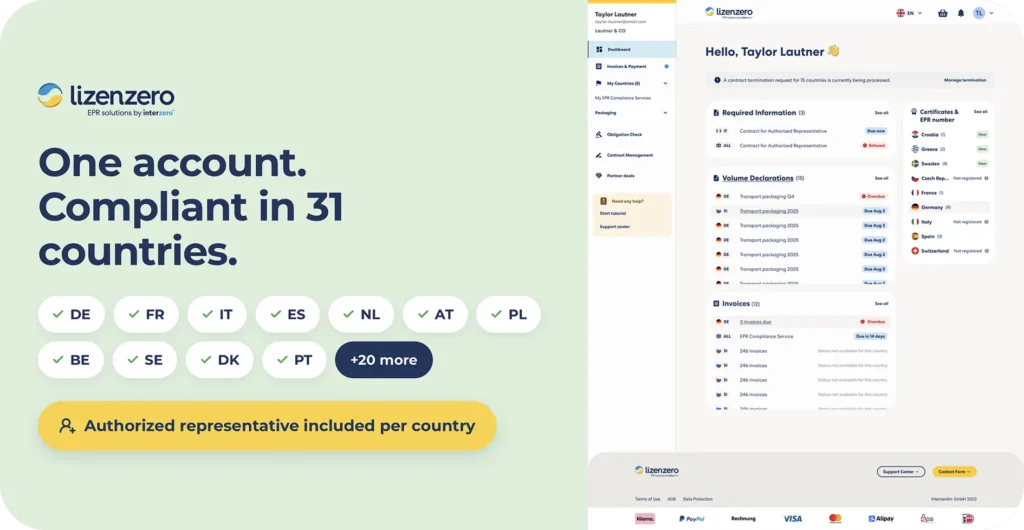
We have teamed up with Lizenzero to provide you the easiest way to comply with the new PPWR regulation. With the full service from Lizenzero.com, you can meet all your obligations in up to 31 countries with ease: one contract, one login, one point of contact. Get a packaging license + an authorized representative in every EU country where you need it.
Use our exclusive voucher code VRPCKLIZ10 to save 10 % at checkout! ¹
Lizenzero Compliance Service
What the Lizenzero service offers you
- Initial country check: For each country, Lizenzero verifies whether you’re actually subject to the local packaging law. You only need the service for countries where obligations apply.
- Complete full service: Registration with authorities, licensing contracts with local recycling schemes, all required volume reports. Lizenzero handles the entire implementation for you.
- Authorized representative included: via digital power of attorney in every target country. The key new PPWR requirement, done in just a few clicks.
- Transparent costs: fixed service fee per country plus a cost forecast calculator for local scheme fees.
- 31 countries, 1 dashboard: all obligations, deadlines, and regulatory changes managed centrally in your digital account — saving you around 100 hours of research.
- 30+ years of EPR experience: Lizenzero is a brand of the Interzero Group, one of Europe’s leading circular economy service providers, with support in 9 languages.
- Volume discount: 5% from 3 countries, 10% from 5, 15% from 8. On top of that, get an extra 10% off with our exclusive voucher code VRPCKLIZ10 ! ¹
Lizenzero
The AuthoriseMe authorised representative service
Behind AuthoriseMe stands the Raan Group, which also owns Reclay, a group with over 20 years of experience in the circular economy and its own take-back systems in several EU countries. AuthoriseMe itself operates as a digital platform and coordinates the authorised representatives in your target countries for you.
With our exclusive voucher code verpackungslizenz24 you save 10% when you sign up via our partner link! ¹
AuthoriseMe Compliance Service
Here’s what the AuthoriseMe service offers you
- Complete full service: registration with the authorities, licensing contracts with local recycling systems, and any volume reporting due. AuthoriseMe handles the entire implementation.
- Authorised representative included: appointed by digital power of attorney in every target country — the key new PPWR obligation, done in just a few clicks.
- Tiered pricing: the cost of the service is based on your annual volumes per country. Up to 100 kg you pay €247, up to 1,500 kg €427, and up to 15,000 kg €877.
- Available in all 27 EU countries: all obligations, deadlines and legal changes in one central digital customer account — saving you around 100 hours of research.
- 20 years of EPR experience: AuthoriseMe draws on the expertise of the Raan Group, which has been running circular-economy operations across Europe for 20 years. If you need EPR services beyond packaging — batteries, WEEE, textiles — you can order these through AuthoriseMe too.
- Partner discount: with our exclusive voucher code verpackungslizenz24 you get 10% off all new country bookings ¹
AuthoriseMe
ecosistant: Tailor-made offers for your EPR compliance
ecosistant is a compliance service provider from Berlin, founded by people who experienced the complex EPR requirements with their own online shop. That’s why the focus is squarely on D2C commerce. ecosistant runs no take-back scheme of its own and is fully independent. Which producer responsibility organisations it works with in a given country comes down to one thing only: the best value for money.
What makes ecosistant different: Every customer gets a personalised package of EPR services, built around actual needs. And ecosistant covers not just packaging but every other relevant EPR category across Europe. So alongside your PPWR obligations, you can settle all your other producer obligations in one go, always with an ecosistant expert at your side.
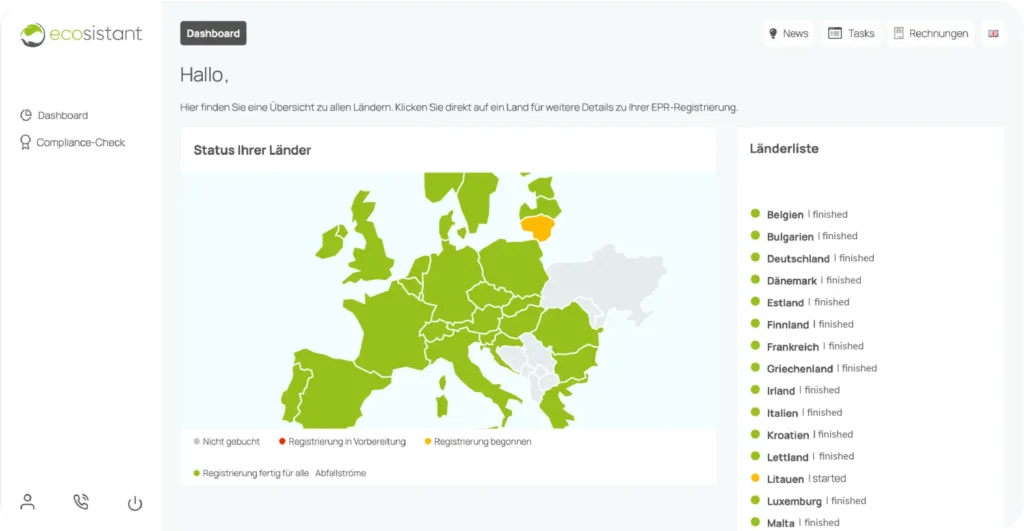
How the EPR Premium Service works: First, an EPR expert reviews exactly which obligations apply to you. You grant a power of attorney, and ecosistant uses it to complete your EPR registrations Europe-wide. From there, ecosistant takes over every recurring task — for example, the ongoing volume reports to authorized representatives, take-back schemes and authorities. You manage the whole thing through one portal that brings every country together in a single place. Over 5,000 companies have used the service, including Wolford, Decathlon and refurbed.
The EPR Premium Service by ecosistant
What the EPR Premium Service from ecosistant offers you
- Initial needs analysis: ecosistant first checks which countries actually place EPR obligations on you. You then decide which EPR categories ecosistant should handle on your behalf.
- Individual offer: For the obligations you select, ecosistant builds you a tailor-made offer.
- Authorized representative included: with your power of attorney, ecosistant completes your registrations Europe-wide — no wrestling with national portals and languages.
- Available in 30 countries: all 27 EU countries plus the UK, Switzerland and Norway
- Personal key account manager: no standard support queue. At ecosistant, an EPR expert is available for your questions at any time.
- More EPR categories: beyond packaging, ecosistant can also cover your obligations for WEEE/batteries, textiles, furniture, toys, single-use plastics and more. The broadest coverage of any provider.
- One portal for your entire EPR compliance: view and manage the status of every EPR category and every country centrally in the ecosistant portal.
- Partner discount: submit your enquiry via Verpackungslizenz24 and you get an exclusive 10% discount on your compliance costs for the first year.
ecosistant
¹Discount on the net value of the goods. No payout possible. One voucher can be redeemed per order and customer. No combination with other discount campaigns possible. Subsequent redemption not possible.
*If a contract is concluded with a provider via a marked partner link, we receive a commission. This does not increase the license price at the respective provider and there are no additional costs.
Frequently Asked Questions about the PPWR
What is the PPWR?
The PPWR (Packaging and Packaging Waste Regulation, Regulation (EU) 2025/40) is the new EU packaging regulation. It regulates uniformly across the EU how packaging must be designed, labeled, and disposed of, and which obligations companies have in the process. It replaces the Packaging Directive 94/62/EC and applies directly in all EU member states from August 12, 2026.
From when does the PPWR apply?
The PPWR entered into force on February 11, 2025, and, after an 18-month transition period, applies bindingly from August 12, 2026. Many individual obligations follow in stages: labeling requirements from 2028, recyclability and recycled-content quotas from 2030, and stricter requirements in 2035, 2038, and 2040.
Am I a "manufacturer" or a "producer" within the meaning of the PPWR?
A manufacturer is anyone who produces packaging or has it produced under their own name or brand. They are responsible for the packaging’s conformity. A producer is anyone who makes packaging or packaged products available in a country for the first time. They are subject to registration, volume reporting, and waste management contributions (EPR). Many companies are both at the same time. Caution: the terms are assigned differently than in the German VerpackG.
Do I need an authorized representative in every EU country?
In every EU country in which you make packaging available for the first time without having an establishment there, you will as a rule need one from August 12, 2026 (Art. 45(3) PPWR). An authorized representative always acts per country; there is no EU-wide one-stop solution. However, there are providers that can supply an authorized representative for you in every country. In that case, there is usually a volume discount. A current EU proposal to partially suspend the requirement for small EU-based companies has not yet been decided.
Does the PPWR replace the VerpackG and the LUCID registration?
No. The PPWR replaces the previous EU directive, not the national implementation. In Germany, the new Packaging Law Implementation Act (VerpackDG) will replace the VerpackG on August 12, 2026, to implement parts of the PPWR in German law. LUCID registration and system participation remain mandatory.
Does the PPWR also apply to small online retailers and Amazon FBA sellers?
Yes. There is no de minimis threshold. The obligations apply from the very first parcel, including when selling via marketplaces and fulfilment programs such as Amazon FBA. Marketplaces even have to verify whether their sellers are registered and suspend listings without valid EPR proof.
How much does an authorized representative cost?
Depending on the country and provider, typically a few hundred euros per country per year, plus the license fees for your packaging volumes and any registration fees. In countries with formal requirements (e.g., a notarized power of attorney in Austria), one-off additional costs may apply. Bundled services for several countries are usually cheaper than individual solutions.
What penalties apply for infringements?
The sanctions are set by the member states (harmonized requirements by February 2027). Even today, they range from fines (e.g., up to €50,000 in Austria, up to €200,000 in Germany, up to seven figures in Spain) to sales bans and the suspension of marketplace listings.
What is the difference between the PPWR and EPR?
EPR (Extended Producer Responsibility) is the principle: whoever places packaging on the market pays for its collection and recycling. The PPWR is the law that regulates this principle – alongside many other requirements – uniformly across the EU.
Does the PPWR also apply to companies from Switzerland, the UK, or the USA?
Yes. Anyone selling packaging or packaged products from a third country into the EU is subject to the same requirements and needs an authorized representative in every EU target country. Under all available drafts, the exemption from the authorized representative requirement currently under discussion is explicitly intended to apply only to EU-based companies.